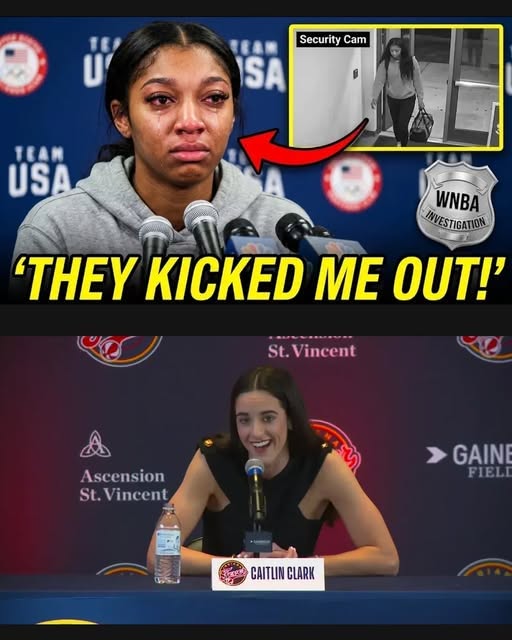

Kaylin Clark fans aren’t happy with Angel Reese. They are freezing her out. Outkick wrote an article and dropped it today. Angel Reese ignores Caitlyn Clark multiple times in Team USA win and the video proves it. The great Joe Henzy wrote that article. Welcome back to the Clark update. WNBA fans, Team USA may have walked away with a win over China, but the conversation after the game is getting far more intense than the final score suggests, and Caitlyn Clark is right in the middle of it. Several viral sequences featuring Clark and Angel Ree have sparked a wave of questions about what was really happening on the floor. Was this nothing more than a team still trying to build chemistry? Was it a problem with the rotations and coaching decisions? Or were certain players simply not understanding the roles they were supposed to play?
Fans are now pushing Team USA for answers, and the debate is only getting louder. There is a lot happening beneath the surface of this victory. So, we’re going to go through the biggest moments, look at what worked, examine what clearly did not, and break down why this situation has become such a major talking point. This is like such a privilege and honor to be here. Like, I don’t I don’t worry about all that. Like, I’m just excited to go play basketball. I remain confident in what I can do. And that’s one of the first messages uh coach Cara told our group when we we first got together when we got here is like be confident in your abilities.
No matter how many minutes you get, whether you’re starting, whether you’re playing a lot of minutes, um whether that’s from game to game, like no matter what, you got to remain the same player and bring what you can bring to this team. And look what Caitlyn said last year. I mean, I thought the game was a little clunky. I felt like we probably didn’t play our best. Um pace really well, but it felt good. I mean, I obviously probably didn’t shoot it as well as I would have liked. I think their zone kind of threw us off. I thought it kind of slowed down our pace a little bit. We didn’t get as much in transition. So, I think if like another team plays zone, just continue to play a lot of pace. Team USA beat China. Sounds simple, right? Not exactly.
Winning the game and actually functioning like a connected basketball team are not the same thing. And this matchup made that difference impossible to ignore. Something happened on the floor that had very little to do with China and much more to do with the way certain American players were approaching their responsibilities. At times, it looked like one player had forgotten what role she was supposed to be filling within this roster. After watching the second game, give your real opinion in the comments. Are Team USA’s lineup issues mostly the result of coaching decisions or are individual players creating problems because of the way they’re playing? Let us know. Yes, the scoreboard says team USA won and technically that is what matters most, but anyone who watched the entire game knows the final score tells only part of the story. The number on the board looked impressive.
Much of what happened around it did not. The offense became disorganized. The decision-making was inconsistent and there were stretches where everything felt unnecessarily chaotic, uncomfortable, and difficult to watch. Meets envy. You get what you saw last night. Caitlyn Clark being shunned out of the game. Iced out of the game. Ignored. Teammates refusing to pass her the ball. We got Angel Ree taking it coast to coast. Caitlin Clark right next to her. Refusing to give her the ball. Going pushing. Giving it to Dear Hamby. And the ball is it’s a turnover. What we saw yesterday was the definition of jealousy. The United States entered its opening World Cup games carrying one of the strongest winning streaks in international basketball. But China arrived with a challenge that looked completely different from almost anything the Americans were used to seeing.

Standing in the middle of it was Jeang Zu, the remarkable 19-year-old who measures 7’3 and immediately forced Team USA to rethink the way it approached the paint. For a stretch, Jeang looked capable of creating a genuine problem for the Americans because her size changed passing angles, altered shots, and made every drive toward the rim more complicated. But eventually, Caitlyn Clark and the younger American group began taking control of the game. Clark finished with 14 points while handing out 11 assists. Jackie Young contributed 12 points and Ryan Howard added 14 of her own. Once team USA found its rhythm, the separation became obvious and the Americans ultimately pulled away for a convincing 94 to61 victory over China. The result also extended the United States’s extraordinary World Cup winning streak to 31 consecutive games. Another reminder of just how dominant this program has been on the international stage.
Damn, says Caitlyn. Get the out of my way. uses her right uses her right forearm to shield Caitlyn from the ball like Kaitlin’s a defender only to push the ball up herself. Kaitlin says, “Oh, you got that.” Oh, okay. My bad. My bad. I I thought I was the point guard here, but you got that. Oh, okay. Okay. Hey, I I I didn’t know. I thought we were on the same team, but you got that. You’re right. You’re the point forward. At least that’s what your fans tell you. Oh, realizes we’re not going anywhere. Think about this sequence for a second. A short clip lasting roughly 24 seconds has been spreading everywhere across social media. And even if you have not seen the actual video, the description alone explains why people are talking about it. China puts up a shot. The ball comes off the rim.

Caitlyn Clark is already there, exactly where a point guard should be when possession changes. She is not trailing the play. She is not stuck on the floor and she is not out of position. She is available at the precise moment Team USA secures the rebound. That is usually when you want the basketball moving directly into her hands. You want Clark receiving it immediately so she can read the floor, push the pace, and attack before the defense gets organized. For a team built with this much speed and offensive talent, that is the logical basketball decision. Angel Ree does her part first by attacking the glass and securing the rebound. And there is absolutely nothing wrong with that portion of the possession. Rebounding is one of the biggest reasons she is valuable. and she handles that responsibility exactly the way Team USA should want.
The problem begins with what happens next. Instead of immediately moving the basketball to Caitlyn Clark, who is positioned right beside her and ready to initiate the transition, Ree keeps possession and nearly barrels into Clark before deciding to bring the ball up the court herself. She starts advancing it as though she is still operating inside an offense where she has point forward responsibilities. Meanwhile, Clark is sprinting alongside her and repeatedly clapping for the basketball. That gesture is universal basketball language. It means, “I’m here. I’m available. Give me the ball and let me organize the possession.” Reys does not make that pass. Then comes the part that made the entire sequence look even worse. Reys attempts the type of long floor stretching pass that Clark routinely makes look almost effortless. But those passes are not actually easy.
They require timing, anticipation, court vision, touch, and the ability to process several moving players at once. Clark has spent years developing those instincts and performs those reads at an elite level. Ree tries it and the play immediately breaks down. Instead of Team USA getting a clean transition opportunity with one of the best playmakers on the floor directing traffic, the possession turns into a messy sequence that coaches absolutely hate seeing. That is the important lesson from this viral clip. Caitlyn Clark makes difficult passes appear routine, but that does not make them routine. That short sequence is almost a perfect demonstration of how quickly things can go wrong when players step outside the roles that best fit their strengths. And before anyone rushes into the comments and turns this into another argument about hating Angel Ree. That is not the point.
This conversation should be about responsibilities, structure, and whether Team USA has clearly defined who is supposed to do what. Right now, those roles do not always look clear enough. In Atlanta, Angel Ree has been asked at times to operate with the ball, create from different areas of the floor and take on responsibilities that extend beyond simply finishing possessions within that system, giving her more involvement in initiating offense can make sense. But Team USA is a completely different environment. Caitlyn Clark is on this roster. Kelsey Plum is on this roster. Team USA has a guard heavy group filled with players whose professional jobs are to handle pressure, push the tempo, read defenses, initiate sets, and create scoring opportunities for everyone else. On this particular roster, Reese’s greatest value is not bringing the ball 80 ft, or trying to throw advanced fullcourt passes.
Her biggest advantage comes from doing the things she can do better than almost anyone. crashing the glass, creating extra possessions, playing physically around the rim, finishing when the defense is vulnerable, and becoming an attacking weapon once the basketball reaches her in the right areas. The important words are once the basketball reaches her. That is different from taking possession away from the point guard before the point guard even gets an opportunity to control the break. Nobody is saying Ree should disappear from the offense. Nobody is saying she should not be on Team USA. The argument is much simpler than that. allow Clark to perform the job she was brought here to perform while allowing Ree to maximize the skills that made her valuable enough to make this roster in the first place. When both players are operating inside those strengths, both of them can look outstanding.

When they are not, the entire possession becomes awkward. One player ends up trying to perform a job that does not naturally fit her, and the other is left running beside the play with her hands clapping while waiting for a pass that never comes. If anyone thinks this concept is overly complicated, go back and look at game one. In stretches where Caitlyn Clark controlled the basketball with specific combinations involving Kelsey Plum, Ryan Howard, Kiki, Emma Billings, and others, Team USA looked like a completely different offensive team. The pace increased. The ball moved with purpose. Players received cleaner opportunities. Defenders were forced to react earlier because Clark’s presence with the ball creates gravity. And once multiple defenders begin paying attention to her, space opens everywhere else. That also helps Angel Ree.
It creates scoring chances for Ree that she may not necessarily generate by herself because Clark can deliver the ball at exactly the moment a defense becomes vulnerable. That has always been one of Clark’s most important qualities. She makes teammates jobs easier. She does not improve the offense by trying to do everything herself. In many ways, she does the opposite. She sees where teammates are going, recognizes openings before they fully develop, and places passes in areas where players can catch the ball and immediately attack or score. Most players simply do not process the floor the same way. Clark also makes those reads so quickly that people sometimes underestimate how difficult they actually are. So, when a teammate decides to keep the basketball and initiate the possession herself instead of giving it to Clark, that is not always just one questionable individual choice.
It can remove the central element that makes the entire offense function efficiently. Team USA still won the second game, so none of this cost them the result. But that does not mean the performance should be ignored. China played stretches of the game with more urgency and more visible energy. Despite Team USA having a roster filled with some of the most talented players in the world, China was quicker to certain actions. China attacked more aggressively. Yes, some of the sluggishness can reasonably be connected to the schedule. Team USA was playing in a back-to-back situation. The group had recently traveled and these players have not spent months building chemistry together. Those are legitimate explanations, but fatigue does not explain every possession. There were clear moments where the basketball ended up in the wrong hands during transition, and it appeared obvious to almost everyone watching.
There is also another issue that makes the discussion more complicated. Caitlyn Clark did not start game two just as she did not start the opener. There are legitimate coaching reasons for experimenting with different groups early in a tournament. Coach Cheryl Lawson has indicated that adjustments will continue and that approach is understandable. The roster has been together for a very short period. They spent only a few days in Miami, traveled internationally, arrived in China, and almost immediately began playing games on consecutive days. Under those circumstances, experimenting with combinations is completely reasonable. The question is, what happens once the experimentation begins giving you a clear answer? If one group repeatedly looks faster, cleaner, and more connected than another, eventually the coaching staff has to decide whether continuing to experiment is helping or simply delaying the obvious.

International tournament basketball moves too quickly to spend forever searching for combinations after one lineup has already started separating itself from the others. Chelsea Gray struggled in game one. She also struggled in game two. There are perfectly valid reasons to remain patient with established players and the coaching staff appears committed to avoiding the kind of reactionary decision-making where someone makes one mistake and immediately gets removed from the floor. That can be a good philosophy. Pulling players immediately after every turnover can destroy confidence and make them afraid to play freely. Coaches often prefer to wait for a positive moment or a natural stoppage before making a substitution. That makes sense. But after what we have seen through the first two games, it would be surprising if Caitlyn Clark is still outside the starting lineup when Team USA faces Italy in game three.
That is not because Clark is somehow entitled to start. Nobody on this roster should be guaranteed anything simply because of reputation. The reason is that the evidence is becoming increasingly difficult to ignore. The eye test is right there. The offensive rhythm with her controlling possessions is visible. And now there is a viral 24-second sequence where she is literally running next to a teammate, clapping for the basketball, and never receiving it. At what point does the evidence become impossible for the coaching staff to overlook? And that brings us to one of the most frustrating parts of this entire performance. Angel Ree refusing to give Clark the ball on one specific possession was not the only problem. Multiple players were attempting things that did not fit their natural strengths, especially in situations where Team USA did not need them to do those things. There were failed passes.
There were players who are not primary ball handlers controlling transition opportunities. There were attempts to reproduce offensive actions that work when Caitlyn Clark performs them because she has spent her entire career developing the timing and skill required to execute them. Those same decisions do not automatically work when another player tries them. There were several moments in game two where it felt as though players were attempting to imitate pieces of what Clark had done successfully in game one. the pace, the passing, the aggressive transition reads, the playmaking angles. But when those actions are not naturally part of your game, the result does not merely become slightly less efficient. It can become extremely obvious. Teammates hesitate because they do not know where the pass is going. The offense slows. Defensive players get additional time to recover. A transition opportunity that should produce an advantage disappears.

Again, Clark’s greatest gift may also create a strange problem. She makes extremely complicated basketball look so simple that other players can watch it and believe they can reproduce the same thing without the years of repetition that made it possible. They cannot, at least not consistently right now. And an international tournament is certainly not the ideal place to begin learning. There is no question that Team USA has an incredible amount of individual talent. That has never been the issue. But team sports are not one simply by collecting the most talented names and putting them in identical jerseys. Great teams require structure. They require clearly defined responsibilities. They require players who understand what they are being asked to do and who are willing to execute those jobs even when someone else’s role looks more glamorous.
Before Team USA moves deeper into this tournament and eventually toward Italy and the more difficult opponents waiting ahead, several things need to become clearer. Caitlyn Clark should be strongly considered for the starting lineup. At the absolute minimum, her role needs to become consistent enough that she is not constantly competing with teammates for control of the basketball when she is supposed to be organizing the offense. When Clark is allowed to run the attack, Team USA looks far more like a connected basketball team. That conclusion is not based only on reputation or fan excitement. We saw it during the first game. Angel Ree also needs to be deployed in a way that maximizes the skills that make her dangerous. She absolutely can be a major weapon for Team USA. Her rebounding is valuable. Her physicality is valuable.
Her ability to finish around the basket when she receives the ball in favorable areas is valuable. Those strengths matter tremendously. But after collecting a rebound, she also has to recognize when the smartest decision is simply giving the ball to the point guard and sprinting into the next action instead of trying to create a role that this roster does not require her to play. Team USA’s coaches need to address these responsibilities now, not after a loss and not after a close game against an opponent that should never have been able to keep the Americans uncomfortable. The longer role confusion goes uncorrected, the more likely it becomes that players turn those decisions into habits. And under pressure, players usually fall back on whatever habits they have developed. Game two showed exactly why that can become dangerous. Team USA is better than the basketball it played against China.
Everyone knows that. But being better on paper is meaningless if the team never proves it through execution. This roster has almost unlimited talent. But talent without organization can turn into nothing more than expensive chaos wearing matching uniforms. If you think the coaching staff needs to step in and establish these roles before the situation grows into a bigger problem, hit the like button, subscribe for more Frank sports commentary, and share your opinion below because we read the responses. After everything we watched, one thing is becoming increasingly obvious. Team USA got the victory, but there is still a long list of things to solve. A 94 to61 win sounds completely dominant when you only see the box score, and there were absolutely plenty of positives. Caitlyn Clark recorded 14 points and 11 assists. Jackie Young scored 12. Ryan Howard finished with 14.

Team USA also extended its remarkable World Cup winning streak. Those are all real positives, but basketball cannot be understood by staring at a final score. The scoreboard tells you who finished with more points. It does not tell you whether the offense consistently made sense. It does not tell you whether five players looked connected. It does not tell you whether the spacing was clean, whether roles were defined, whether possessions were being initiated by the correct player, or whether the rotations are moving this roster closer to the version it needs to become. That is why the next matchup could tell us far more than this victory did. Clark has already demonstrated exactly what she can add. Her passing changes possessions. Her tempo can force defenses into uncomfortable decisions. Her vision creates opportunities that other players may not recognize.
And once she starts controlling the flow of the game, teammates often become better simply because they receive the ball in better positions. Angel Ree can affect the team in an entirely different way. Ree gives team USA physical rebounding, interior strength, second chance possessions, pressure around the rim, and a player capable of making opponents work on every missed shot. That combination can be extremely useful. So, this should not become a debate about whether Ree deserves a place on the roster. The much more useful question is how her strengths fit beside Clark’s strengths and everyone else’s. That is exactly where coaching matters most. If one player believes she should bring the ball up, another believes she should initiate the offense and somebody else begins attempting difficult passes that fall outside the responsibilities she normally handles, the offense can unravel in seconds. That does not automatically prove jealousy.

It does not prove anybody is intentionally freezing Caitlyn Clark out. And one short video circulating on social media cannot tell us everything happening inside a team. But when similar sequences keep appearing and fans repeatedly notice the same kind of confusion, it becomes fair to ask whether Team USA’s offensive hierarchy needs to be clearer. A group this talented should not repeatedly look uncertain about basic responsibilities. We also cannot ignore the reality that this team is still learning how to play together. These athletes have not spent an entire WNBA season building chemistry with one another. They are learning tendencies in real time. They are learning where teammates prefer to receive passes, when guards want screens, where cutters are going to move, who likes to run in transition, and how quickly each player processes defensive rotations. Normally, those details develop over weeks and months.
Team USA is trying to build them during an international tournament. That requires patience. But tournament basketball does not provide unlimited patience. Every game moves the team closer to tougher opposition and eventually experimentation has to produce decisions. That is why the coaching choices from here become so interesting. Does Caitlyn Clark eventually enter the starting five? Does she begin receiving a larger and more predictable share of the minutes? Does Team USA place more of the offense in her hands? Does Ree become more clearly defined as a rebounder, interior scorer, screener, and second chance weapon? Do Kelsey Plum and the rest of the guards take on different responsibilities? Does coach Carol Lawson keep rotating combinations and searching for something better? Those answers will reveal what the staff believes the best version of Team USA actually looks like.
But there is one larger point that should not get buried beneath the arguments online. This does not need to become another Caitlyn Clark versus Angel Reese battle. Social media would love that because conflict generates clicks. Someone posts one clip, one side blames Ree, another side attacks Clark. Fans choose teams, old arguments return, and suddenly a legitimate basketball discussion turns into another personal feud. That should not be the objective here. The objective is winning. If Clark, Ree, Plum, Howard, Young, and the rest of this group understand how their individual abilities connect, Team USA could become incredibly difficult to beat. Clark does not need 30 points every night to control a game. Ree does not need to dribble the basketball from one end of the court to the other on every rebound to have a massive impact. Plum does not need to create everything by herself.

Every player has something specific that makes her valuable. Championship level teams become special when every player accepts that value and stops trying to become something the roster does not need. So when you watch the next game, do not focus only on the obvious statistics. Do not watch only who starts. Do not judge everything by who scores the most or who receives the most minutes. Watch the spacing between players. Watch how quickly the ball moves after a rebound. Watch who actually initiates the offense. Pay attention to where Caitlyn Clark is standing when possessions begin. Watch how Team USA positions Angel Ree. Notice whether teammates naturally find one another or whether players are still hesitating. Those details will tell us far more about Team USA’s development than any 22nd viral clip ever can.
If the Americans solve those issues while maintaining the talent, athleticism, and energy already available on this roster, the rest of the tournament could become terrifying for every opponent. The China game proved Team USA can win comfortably on the scoreboard. Now, the challenge is proving that it can become equally dominant through chemistry, decision-m, execution, and consistency. So, tell me what you think Team USA needs to change before the next game. Should Caitlyn Clark receive a larger offensive role? Is it time to change the starting five? Should Angel Reese concentrate even more on rebounding, interior play, and the things she already does exceptionally well, or are fans taking a handful of possessions and turning them into something much bigger than they really are? And above everything else, what do you believe is the biggest issue at the moment? Coaching, chemistry, or unclear player roles?
Put your answer in the comments because I want to hear where you stand. If you enjoyed this breakdown, hit the like button, subscribe to the Clark update, and turn on notifications so you do not miss what comes next. This tournament is still in its early stages. Victories matter, individual performances matter. But if Team USA wants to reach its full potential, chemistry might ultimately matter more than either of those things. With Caitlyn Clark, Angel Reese, Kelsey Plum, and the rest of this incredibly gifted American roster, there will be no shortage of moments to analyze as the tournament continues. Stay locked in because the next matchup may finally show whether Team USA has discovered the combination it has been searching for. And if that happens, every team waiting later in the competition should pay attention. This is the Clark update and we’ll see you in the next