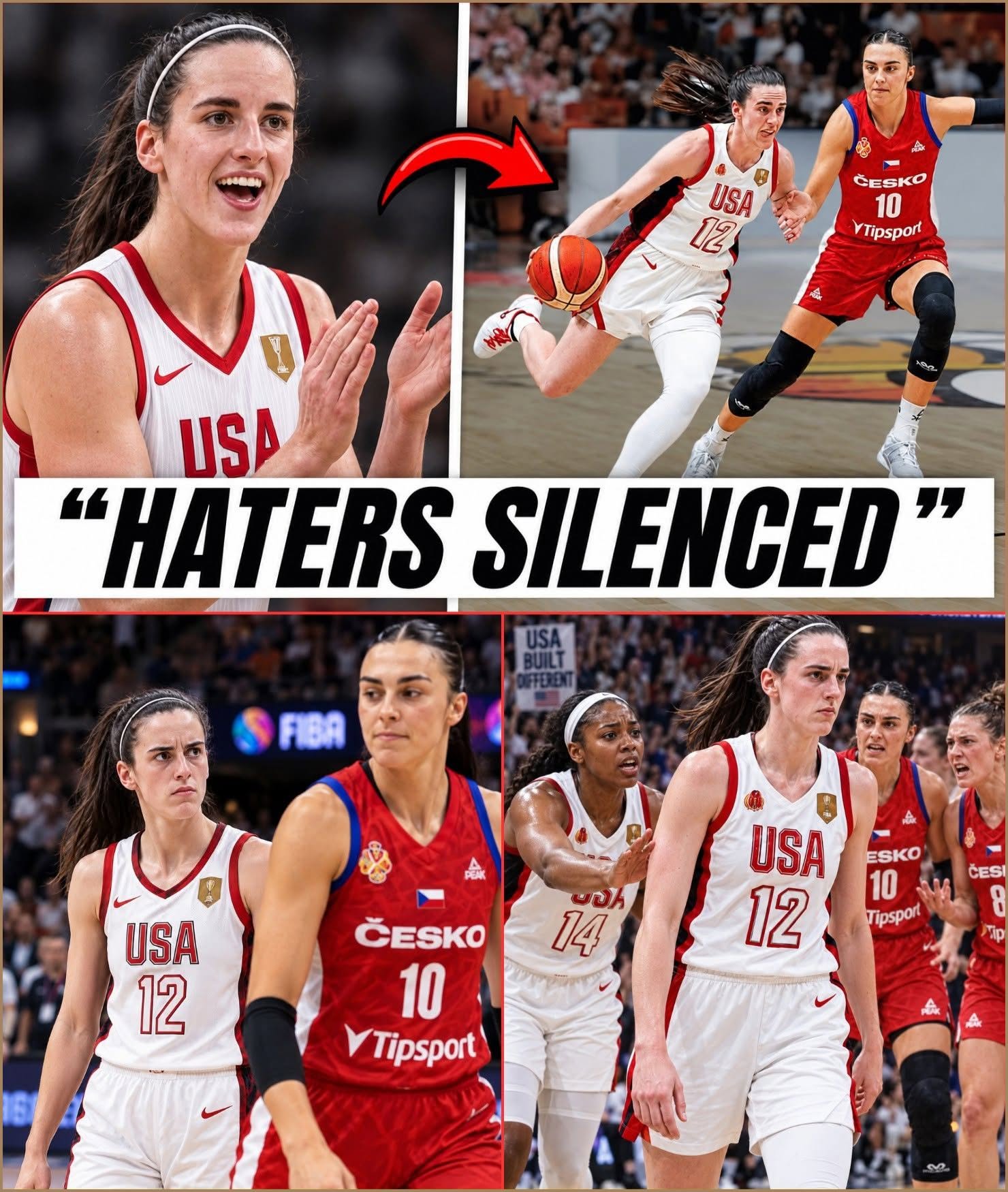

Caitlin Clark Didn’t Need a Huge Scoring Night to Answer the Critics — She Controlled Everything That Mattered
Caitlin Clark walked into the game against Czechia carrying something heavier than a basketball.
She was carrying the reaction to what had happened against Italy.
One difficult performance had been enough for the criticism to explode. Suddenly, the conversation was no longer about one bad night. It became about whether Clark could handle international basketball, whether the expectations around her had become too large, and whether Team USA might actually be better when she was not at the center of everything.
That is what happens when a player becomes as visible as Clark.
A great game is expected.
A bad one becomes evidence.
So when she checked into the game against Czechia late in the first quarter, there was an obvious temptation waiting for her.
Force the issue.
Take the first available three.
Try to erase the previous game in five minutes.
Clark did almost the opposite.
And that may have been the most impressive part of her response.

She Entered the Game Looking to Organize, Not Impress
Team USA had already started with far more urgency than it showed against Italy.
Breanna Stewart was aggressive early.
Napheesa Collier finished inside.
Jackie Young and Kahleah Copper knocked down perimeter shots.
The pace was better, the spacing looked cleaner, and the Americans were clearly determined not to allow another opponent to drag them into an uncomfortable game.
Then the offense slowed.
Shots stopped falling.
That was when Clark came in.
Almost immediately, she changed the rhythm without needing to dominate the ball.
She found Rhyne Howard on the perimeter.
She recognized Stewart cutting toward the basket and delivered another pass.
Instead of using her first few possessions to announce herself as a scorer, Clark began manipulating the defense.
That was important.
She did not look like someone trying to prove she was better than the critics said.
She looked like a point guard trying to make the game easier.
There is a difference.

The Best Answer Was Patience
Clark eventually found her own offense.
She created separation and knocked down a jumper.
She grabbed a rebound and pushed the ball back the other way.
But the performance never became a desperate search for points.
That was exactly what Team USA needed.
By the end of the first quarter, the Americans had built a 29-15 lead.
The game was already moving in a completely different direction than the Italy matchup.
And Clark had helped change it without hijacking it.
That became the theme of the night.
When she had a scoring opportunity, she took it.
When the defense shifted toward her, she passed.
When nothing was available, she stayed patient instead of manufacturing something that wasn’t there.
For a player whose reputation has been built partly on spectacular shots from absurd distances, the most interesting thing she did against Czechia was show restraint.
Team USA Finally Looked Like a Complete Team
The biggest difference from the previous game wasn’t simply Clark’s performance.
It was everyone else’s.
Angel Reese brought energy around the basket.
Paige Bueckers created offense and defended with activity.
Stewart was consistently involved.
Howard, Young, Collier and the rest of the rotation helped prevent the offense from becoming dependent on one player solving every possession.
That balance mattered.
When Clark returned in the second quarter, Team USA had already created separation.
She did not need to rescue the game.
She only needed to continue reading it.
Late in the half, she broke down the defense and once again found Stewart cutting inside.
It was not the kind of play that dominates highlight reels.
But it was exactly the kind of possession that makes an offense difficult to defend.
Clark attracted attention.
Stewart recognized the space.
The pass arrived.
Easy basket.
By halftime, Team USA led 57-33.
The pressure Clark had carried into the game was already beginning to disappear.

Her Passing Made the Defense Choose
The third quarter showed why Clark can be dangerous even when she isn’t having one of her famous scoring explosions.
Defenses have to make a decision when she has the ball.
Stay attached to shooters and allow Clark room to attack?
Or step toward her and risk opening someone else?
Clark punished both choices.
She attacked and drew fouls.
She created separation for another jumper.
Then, when the defense began reacting more aggressively, she started finding teammates again.
One of the clearest examples came when she drew attention and located Aliyah Boston outside the arc.
Boston knocked down the three.
That play explained Clark’s value perfectly.
The pass mattered.
But the real damage happened before the pass.
Clark’s scoring reputation forced the defense to shift.
That movement created the opportunity.
Elite playmakers do not simply find open teammates.
They help make teammates open.
Clark did that repeatedly.
She Didn’t Need to Chase a Redemption Story
There is something dangerous about entering a game determined to “make everyone regret” criticizing you.
That mindset can become emotional very quickly.
Players begin shooting when they should pass.
They try to create highlights instead of good possessions.
They start competing against the conversation rather than the opponent.
Clark avoided that trap.
She let Czechia determine what the game required.
If the defense gave her space, she attacked.
If a teammate had the better opportunity, she moved the ball.
That maturity may have mattered more than any single shot she made.
The previous performance against Italy had been poor.
There was no need to pretend otherwise.
But one bad game does not need to become two.
Clark understood that.
The Fourth Quarter Put the Final Touch on It
By the final period, Team USA had completely taken control.
The younger group continued playing aggressively.
Reese worked around the rim.
Bueckers continued creating.
Kiki Iriafen brought energy inside.
Sonia Citron found scoring opportunities.
Then Clark got the kind of moment many fans had probably been waiting for.
She rose into a pull-up three and buried it.
It was only one shot.
The game was already decided.
But after the shooting struggles and criticism from the Italy performance, it felt like a small exclamation point.
Still, Clark’s final contribution may have been more appropriate.
She found Reese underneath for another assist.
The last meaningful image of her night wasn’t Clark celebrating a difficult three.
It was Clark creating an easy basket for someone else.
That was the whole story.
Seven Assists Said More Than Nine Points
Clark finished with nine points and seven assists.
If someone had predicted before the game that her big response to criticism would be a nine-point performance, it probably would not have sounded particularly dramatic.
But box scores need context.
Seven assists meant Clark was consistently creating offense.
She was finding cutters.
She was taking advantage of defensive mistakes.
She was turning pressure into opportunities for teammates.
Most importantly, she wasn’t trying to transform the game into a personal revenge mission.
That is what made the performance valuable.
She helped Team USA win by 41 points while allowing the offense to remain balanced.
Sometimes a star proves her importance by taking over.
Sometimes she proves it by understanding when not to.
One Poor Game Was Never Going to Settle the Debate
Clark’s popularity guarantees that every performance will be magnified.
There is almost no middle ground.
When she plays well, people talk about greatness.
When she struggles, people begin questioning everything.
That environment isn’t going away.
But the Czechia game provided a useful reminder.
International basketball is not a nightly referendum on whether Caitlin Clark belongs.
It is a tournament.
There will be good games.
There will be bad games.
What matters is how quickly a player adjusts.
Against Czechia, Clark adjusted.
She played within the flow of the offense.
She created for teammates.
She chose her shots more carefully.
And Team USA looked much more like the overwhelming group everyone expected to see.
The Bigger Tests Are Still Ahead
A 105-64 win does not answer every question about Team USA.
Czechia was overwhelmed.
Future opponents may not be.
Eventually, there will be a game where the Americans cannot build a 20-point lead before halftime.
There will be possessions where the defense is set, the clock is shrinking, and the margin is only one or two.
That is when Clark’s decision-making will matter even more.
Can she create the same easy opportunities under real pressure?
Can she stay patient when the game becomes chaotic?
Can Team USA trust her to control those possessions?
Those questions remain.
But after what happened against Italy, Clark needed to show that one difficult night had not changed the way she approached the game.
Against Czechia, she did exactly that.
She did not score 30.
She did not need to.
She simply played smarter, stayed composed, created seven assists and helped Team USA turn a potential response game into a 41-point demolition.
The critics were waiting for an answer.
Clark gave them one.
It just came through control rather than chaos.