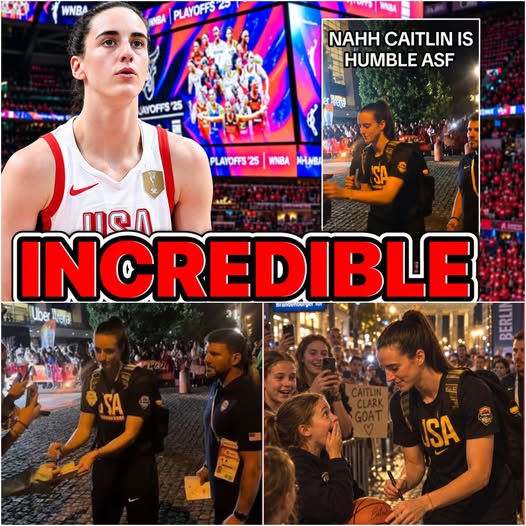

Caitlin Clark was supposed to be getting on the bus.
Team USA had places to be, coaches were already moving toward the vehicle, and the usual post-event routine appeared to be unfolding exactly as expected.
Then Clark noticed the fans waiting nearby.
And instead of walking straight past them, she stopped.
What happened next lasted only a few minutes, but it quickly became one of those moments that says more about an athlete’s popularity than almost any statistic ever could.
On the streets of Berlin, thousands of miles from Indiana and even farther from the college arenas where her rise first became a national phenomenon, Clark found herself surrounded by young supporters hoping for one thing.
A signature.
She began signing.
One after another.
Quickly, efficiently, smiling and acknowledging the people who had waited for her.
And suddenly a simple walk toward a team bus became another reminder that the Caitlin Clark phenomenon is no longer confined to the United States.
It has gone global.

She Could Have Walked Straight Onto the Bus
That is what makes the moment interesting.
Professional athletes are constantly moving.
There are games, practices, media obligations, travel schedules and security concerns. During international tournaments, that routine becomes even more demanding.
Nobody would have been shocked if Clark had simply waved to the fans and continued walking.
Instead, she stopped.
Young fans pushed forward with basketballs, jerseys and items waiting to be signed. Clark moved through them quickly, putting her autograph wherever she could before finally heading toward the bus.
There was no elaborate ceremony.
No microphone.
No staged meet-and-greet.
Just an athlete recognizing that some of those people may have waited hours for a five-second interaction.
For Clark, it was another autograph.
For a child standing on a Berlin street, it may have been the highlight of the entire week.
That difference is easy to underestimate.
Berlin Has Revealed Something Bigger Than Basketball
Clark’s international trip has provided a fascinating glimpse into just how widely her name now travels.
American basketball stars have long had global followings, but women’s basketball is entering a different era.
The crowds are bigger.
The conversations are louder.
Social media allows highlights to reach another continent almost instantly.
And Clark arrived at exactly the right moment.
Fans who may never have attended an Indiana Fever game know the No. 22 jersey.
They know the deep three-pointers.
They know the passes.
They recognize the player walking down the street.
Berlin made that impossible to miss.
The most striking part of the autograph footage wasn’t simply that fans approached Clark.
It was the familiarity.
They weren’t reacting as though they had stumbled upon an athlete they vaguely recognized.
They had come prepared.
They wanted her signature.
They wanted photographs.
They knew exactly who they were waiting for.
That is a different level of fame.
The “Caitlin Clark Effect” Looks Different Overseas
For years, the phrase “Caitlin Clark effect” has been attached to ticket sales, television audiences, merchandise and packed arenas.
Those are easy things to measure.
But there is another version that doesn’t fit neatly into a spreadsheet.
It looks like a crowd forming outside an arena in another country.
It looks like children waiting on a sidewalk.
It looks like jerseys thousands of miles from the city where Clark plays professionally.
And it looks like the Team USA bus waiting while one player finishes signing.
That may be the clearest sign of how much the landscape around Clark has changed.
Her popularity is no longer something that appears only when she enters an arena.
She carries it outside with her.
The game can be over.
The scoreboard can be turned off.
And people still gather.
Fame Can Separate Athletes From Fans -Clark Keeps Closing the Distance
There is a strange contradiction that comes with becoming famous.
The more people want access to you, the harder access becomes.
Security increases.
Schedules become tighter.
Crowds become larger.
Eventually, even the smallest interaction requires planning.
That can create distance between athletes and the people who helped make them famous.
Clark has reached the stage where that distance would be understandable.
Yet some of her most memorable recent moments have involved doing the opposite.
Stopping for supporters.
Acknowledging children.
Taking photographs.
Signing something before moving on.
None of those actions make a player better at basketball.
But they can make someone care about basketball more.
That distinction matters.
A child who gets Clark’s autograph in Berlin might go home and start following women’s basketball more closely.
She might want to play.
She might ask for a ball.
She might wear No. 22.
Sports grow through moments exactly like that.
Not because anyone planned them as marketing campaigns.
But because fans remember how athletes made them feel.
The Scene Also Showed the Strange Reality of Clark’s Fame
Perhaps the most revealing image is Clark arriving at the bus after many others had already moved toward it.
That tiny detail says a lot.
She is part of Team USA.
But she also travels inside a spotlight that sometimes feels separate from the team itself.
Where Clark goes, cameras follow.
Where Clark stops, crowds form.
Where Clark signs, phones appear.
That level of attention can create enormous opportunities, but it can also create pressure.
Every gesture becomes a story.
Every reaction is analyzed.
Every decision can become a debate online.
Even something as ordinary as signing autographs outside a team bus can suddenly spread across social media.
But in this case, the attention revealed something refreshingly uncomplicated.
Fans wanted to meet her.
Clark gave them a moment.
That was enough.
This Is Why Her Influence Cannot Be Explained by Statistics Alone
There will always be numbers attached to Caitlin Clark.
Points.
Assists.
Three-pointers.
Wins.
Minutes.
Records.
Basketball naturally reduces performance into statistics because statistics are easy to compare.
Influence is harder.
There is no official box score for the number of children who started watching because of one player.
There is no assist credited when a young fan decides to pick up a basketball after meeting her favorite athlete.
There is no statistic for the distance someone travels just hoping for an autograph.
Yet those things may ultimately say more about Clark’s place in the sport than another 25-point game.
Berlin offered a glimpse of that.
Not inside the arena.
Outside it.
Sometimes the Smallest Moment Becomes the Biggest One
Eventually, Clark finished signing and stepped toward the bus.
The crowd remained behind.
Team USA moved on.
The entire scene was over almost as quickly as it started.
But dozens of fans walked away carrying something they hadn’t had before.
A signature.
A photograph.
A brief interaction.
A story.
And that is probably why the footage connected with so many people.
It wasn’t dramatic because Clark did something extraordinary.
It was powerful because she did something simple.
She could have kept walking.
Instead, she stopped.
And on a street in Berlin, far from home, Caitlin Clark showed that her biggest impact may not always come from the shots she takes.
Sometimes it comes from the people she chooses not to walk past.