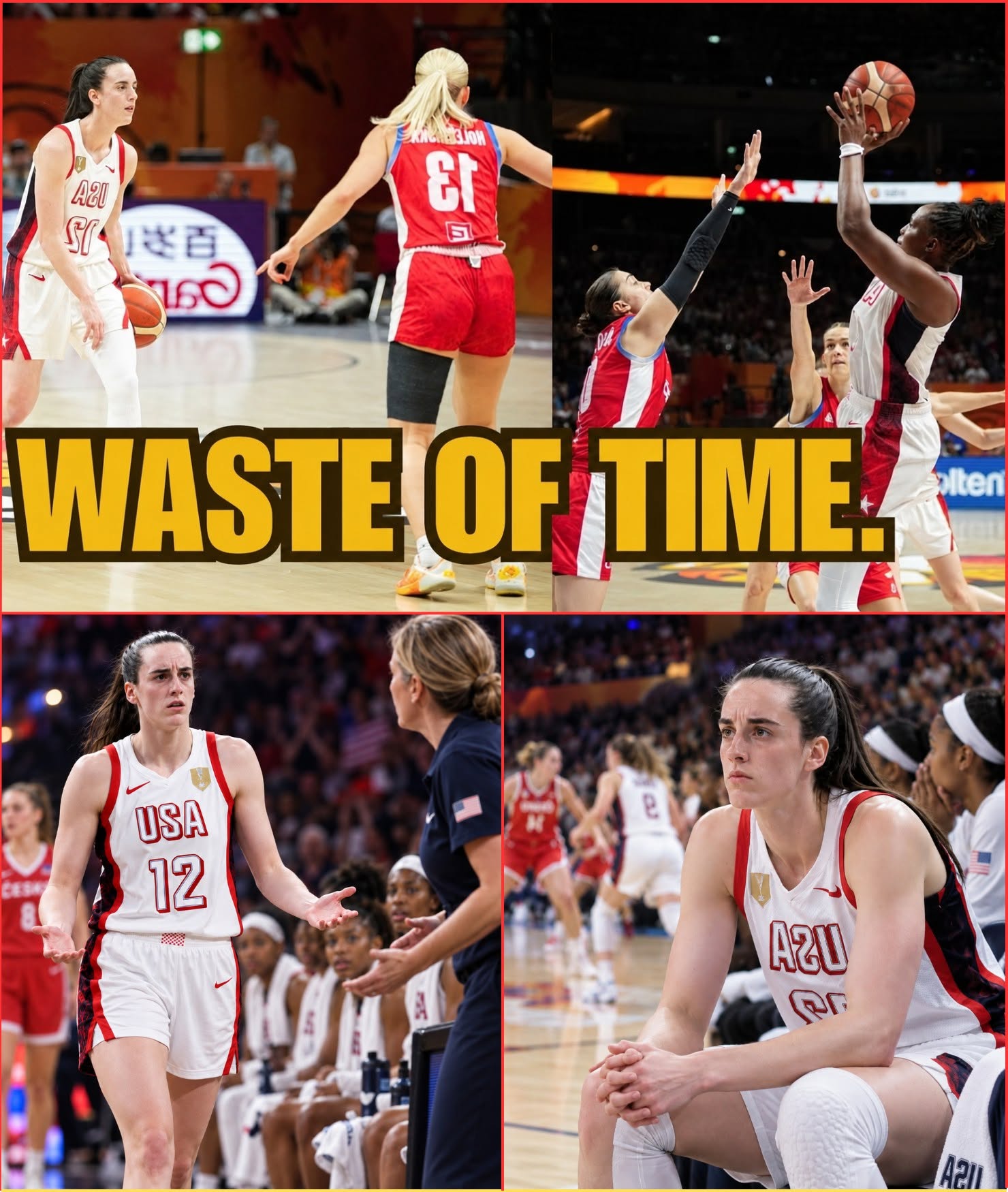

Caitlin Clark Led Team USA in Assists Against Czechia — So Why Did Her Role Still Feel So Small?
Team USA won by 41 points.
Caitlin Clark led the team in assists.
And somehow, instead of ending the night with everyone talking about another dominant American victory, the conversation quickly turned into something much more uncomfortable.
Why did one of Team USA’s most productive playmakers still seem to spend so much of the meaningful portion of the game waiting for her opportunity?
That question became impossible to ignore after the United States defeated Czechia 105-64, securing another comfortable result in the tournament.
Clark finished with nine points, seven assists and one rebound while posting a plus-22.
Seven assists were more than anyone else on Team USA.
On the surface, that sounds like a productive night.
But for many watching closely, the box score didn’t completely match the feeling of the game.
Clark played more than 20 minutes, yet a significant portion of those minutes came after Team USA had already blown the game open.
And that is where the argument begins.
The Numbers Look Good — But When Did the Minutes Come?
If someone checked only the final box score, there would appear to be very little reason for concern.
Clark played substantial minutes.
She created offense.
She helped Team USA win easily.
Case closed.
But basketball rotations are about more than the final number beside a player’s name.
When those minutes happen matters.
Who is on the floor when the game is still competitive matters.
Who controls the ball when the score is close matters.
Who the coaching staff trusts at the beginning of quarters matters.
Against Czechia, Clark’s extended run came largely after Team USA had built an enormous advantage.
By that point, the game had changed.
There was less pressure.
Mistakes were less costly.
The result was no longer seriously in doubt.
So while Clark ultimately accumulated more than 20 minutes, critics of the rotation came away asking whether she is truly being treated as one of Team USA’s primary weapons or simply as an extremely talented reserve who gets additional time once the game is under control.
Those are two very different roles.
Seven Assists Make the Situation More Interesting
The reason this debate refuses to disappear is simple.
Clark continues to create offense even without being given full control of it.
Seven assists do not happen accidentally.
Clark’s most dangerous skill has always been her ability to see plays before they fully develop.
She can push the ball in transition.
She can find cutters.
She can hit teammates ahead of the defense.
She can turn an ordinary possession into an open shot with one pass.
And she can do all of that even when her own shot is not falling.
Against Czechia, Clark didn’t have a spectacular scoring game.
She didn’t need one.
The passing was enough to change possessions.
That is why fans are increasingly asking a very basic question:
If Clark can lead Team USA in assists while coming off the bench, what might happen if the offense were placed in her hands from the beginning?

The Chelsea Gray Comparison Is Becoming Inevitable
Any conversation about Clark’s role eventually leads to Chelsea Gray.
Gray is a veteran.
She has championship experience.
She has played in enormous games and earned trust over years of elite basketball.
That history carries weight, especially in international competition where coaches often value stability and experience.
But tournaments also create their own reality.
What a player accomplished years ago is not the same thing as what that player is producing today.
According to the numbers cited throughout the discussion after the Czechia game, Clark had accumulated 24 points and 18 assists through the first three World Cup games.
Gray, meanwhile, had 11 points and three assists.
That comparison immediately became fuel for those who believe Clark should already be starting.
The argument isn’t necessarily that Gray suddenly became a bad basketball player.
It is that Clark appears to be creating more right now.
And at some point, current production has to matter.
How much should seniority influence a lineup when another player is generating significantly more assists?
How long does experience outweigh immediate impact?
Those are legitimate questions.
Clark Hasn’t Been Perfect
There is also another side of this conversation that deserves to be acknowledged.
Clark has not been flawless in this tournament.
Her scoring has been inconsistent.
There have been missed shots.
There have been stretches where she hasn’t imposed herself on the game.
She is playing with different teammates in a different system and adjusting to international basketball.
That matters too.
Starting Clark isn’t automatically a magic solution to every Team USA problem.
But what separates her is the fact that she can still influence a game when she isn’t scoring efficiently.
A pure scorer can become much less valuable when the shots stop falling.
A playmaker still has options.
Clark can miss several threes and still create seven assists.
She can still speed up the offense.
She can still force defenders to make decisions.
She can still make life easier for four other players on the court.
That versatility is exactly why the debate over her role has grown.

And Clark Isn’t the Only Young Player Making Noise
The larger issue surrounding Team USA may go beyond Clark.
Angel Reese had a productive performance.
Paige Bueckers gave the team efficient offense.
Sonia Citron made the most of her opportunities.
Several of the younger players looked more than capable of contributing.
But because the game became a blowout, it was difficult to determine how much of that performance will actually influence the rotation when the next game is close.
That’s the uncomfortable part.
Young players can dominate late in a 30- or 40-point game and still find themselves back on the bench when the next opponent creates real pressure.
That may be understandable from a coaching perspective.
Veterans usually receive the benefit of the doubt.
But eventually, performance has to create consequences.
If younger players continue producing, the coaching staff may have no choice but to reconsider who deserves the biggest roles.
Breanna Stewart Showed What a Featured Role Looks Like
One veteran who clearly delivered against Czechia was Breanna Stewart.
Stewart finished with 19 points, seven rebounds and six assists, giving Team USA exactly the kind of all-around performance expected from one of its biggest stars.
More importantly, she looked featured.
The offense flowed through her.
She was involved.
She was given opportunities to impact the game in multiple ways.
And that’s part of what makes Clark’s situation so fascinating.
When a player is truly featured, you can feel it.
You don’t need to wait until the final box score.
Their fingerprints are everywhere.
Clark, despite leading the team in assists, often seemed to be operating around the offense rather than being placed at the center of it.
That difference is subtle, but important.
The Real Test Won’t Come in a 41-Point Blowout
Ultimately, Czechia cannot answer the most important question.
Team USA won too easily.
The game never forced the coaching staff to reveal its deepest level of trust.
The real answers will come when the United States faces an opponent that refuses to disappear.
Imagine Team USA tied with four minutes left.
The offense has gone cold.
Every possession matters.
Who brings the ball up?
Who makes the first decision?
Who creates the shot?
Who does the coaching staff trust?
That will tell us far more about Clark’s real role than any 20-minute appearance in a blowout.
Because there is a major difference between playing Caitlin Clark and trusting Caitlin Clark.
Right now, Team USA is clearly willing to play her.
Whether the team is ready to fully trust her with the offense is a different question.
Winning Keeps the Controversy Quiet — But Only Temporarily
As long as Team USA keeps winning, there will be no crisis.
A 105-64 victory gives coaches plenty of room to defend their decisions.
Nobody needs to panic after a 41-point win.
But dominance can hide difficult questions.
And the question surrounding Caitlin Clark is getting harder to avoid.
She led Team USA in assists against Czechia.
She contributed without needing a huge scoring night.
She continued to show why her passing can transform an offense.
Yet when the game still felt meaningful, she didn’t always feel like one of the central figures on the floor.
Maybe that changes in the knockout rounds.
Maybe experience continues to win out.
Maybe the current rotation takes Team USA all the way to the title and makes the entire debate irrelevant.
But if the Americans eventually find themselves in a close game struggling to generate offense, everyone will remember what Clark has already shown.
She doesn’t necessarily need 25 shots.
She doesn’t need to score 30.
Sometimes she only needs the ball, a little freedom, and teammates willing to run.
And after another game in which she led Team USA in assists from a reserve role, the biggest question is no longer whether Caitlin Clark can help this team.
It’s how long Team USA can keep treating one of its most productive creators like she has something left to prove.