

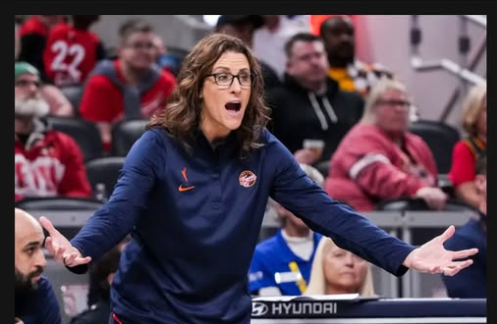
And there’s a lot of us trying to figure out exactly what’s going on here. We think Caitlyn Clark is screaming at either Brienne January or Stephanie White and she is losing her mind. You are allowed yourself, you’re allowing your defense to get loaded and Indiana not playing in transition. your you are allowed yourself you’re allowing your defense to get loaded and Indiana I thought she said something about getting backend help and then she goes [ __ ] I think that’s what she said I may be wrong I may be totally whatever Caitlyn Clark was saying there she was clearly animated and that moment came while Indiana was already getting punched in the mouth but the real story is not one frustrated exchange change.
The real question is why this team looked completely unprepared once Washington started exposing the weak spots.
VIDEO:
Guys, I I don’t have any idea what Stephanie White was thinking, but I do know one thing. This game fully exposed something that so many people have been pointing out, including myself, from like six weeks before the season started after the draft and free agency was over. And we took a look and said, “Is this the roster? This is the roster.” This game fully exposed and by the way the last game to a certain extent exposed the lack of depth and bench on this team. That is the warning right there. The concern did not suddenly appear because Indiana had one ugly night. The argument being made is that the roster construction was questionable before the season even started and this game simply made the issue impossible to ignore. And there is an important distinction between losing and getting exposed. Good teams lose games.
Contenders have nights where shots do not fall. But when one opponent can expose multiple structural problems at the same time, that is different. Now you are talking about whether the team has enough playable combinations, enough reliable scoring outside the stars, and enough flexibility when the original game plan is not working. Keep that in mind because later we need to talk about the strangest part of this entire game, Indiana’s minutes distribution. That is where the situation gets much harder to explain. This team has no bench. This team has no bench. And some of these cleaning numbers in this game far as actual minutes played a little confusing from Stephanie White. So, the Washington Mystics went into Indiana, beat the [ __ ] out of them. J, I’m just going to keep it real. There’s no confusion, no sugar coating.

I mean, just pretty much whipped them like a dog, took a big lead, and never really looked back. This team has no bench. That is a brutal assessment, but now we can actually test it against what happened. Washington did not slowly grind Indiana down in the final minutes. The game got away from the fever early enough that Indiana had to start chasing instead of dictating. Once that happens, your secondary players become incredibly important. Your stars can create advantages, but somebody still has to punish the defense when it rotates. If those players cannot do that consistently, the opponent gets a luxury most teams do not want to give them. They can load up on Caitlyn Clark. They can stay attached to Kelsey Mitchell. They can shrink driving lanes. They can gamble more aggressively because the punishment coming from the weak side is not scary enough.
That is when a roster issue stops looking like a box score problem and starts changing the geometry of the entire offense. Uh, Caitlyn Clark, Kelsey Mitchell, like the other night they had pretty big games in this. However, the other night I pointed out they won that game. Marina Mayberry, Britney Sykes did not play. Okay, that game was pretty tight until about the last six or seven minutes. Look what just happened when the other team has all of its dogs playing. They just got blown out. They just got massacred. And this comparison matters. The previous game was close deep into the fourth quarter with Marina Mabberry and Britney Sykes not playing for Washington. Then Washington came back with a stronger lineup and the entire picture changed. That does not automatically mean Indiana cannot beat Washington. Basketball does not work that neatly.
Matchups change, shooting variance changes, players have better nights and worse nights, but it does raise a much bigger playoff question. What happens when Indiana faces a team that has its primary scorers available, its defensive personnel available, and enough depth to maintain pressure after the first substitutions? Because playoff basketball removes excuses very quickly. Rotations shrink. Opponents study every action. Weak defenders get hunted. Non-shooters get ignored. Teams make you prove possession after possession that your fifth, sixth, and seventh options can survive. And Indiana cannot build a serious postseason plan around Caitlyn and Kelsey producing heroic offensive stretches every night. That might win you a game. It is much harder to build an entire series around it. This was a blood bath. Kaitlin Clark 25 points, five assists, two rebounds. She only had five assists because nobody could hit a shot. Aaliyah Boston, I don’t know what happened here.
Aaliyah Boston only had 19 minutes in this game and seven points. Monnique Billings, zero points. Lexi Hall, two points. Mercedes Russell two points. Mahisha Allen two points. Mercedes Russell zero points. Excuse me. Raven Johnson played 26 minutes. What? Six points. But 26. Now we get to the numbers that make the frustration understandable. The commentator credits Caitlyn with 25 points and five assists, while Aaliyah Boston played only 19 minutes and scored seven. Monnique Billings had zero points. Lexi Hall had two. Other bench contributions were minimal. Then Raven Johnson suddenly logged 26 minutes. And that last number is where this stops being a simple the bench played badly conversation. 26 minutes is not a random cameo. That is a major rotation role. So what was Stephanie White trying to accomplish? Maybe she was protecting certain players physically. Maybe she was experimenting before the playoffs.
Maybe there was a matchup she believed Raven could exploit. Maybe she wanted another ball handler on the floor. Those are all possible explanations. But if you make an unusual rotation decision during a blowout loss, fans are naturally going to question it, especially when the lineup never develops enough offensive rhythm to justify the experiment. The problem was not simply that Indiana missed shots. The problem was that viewers were watching combinations they were not accustomed to seeing while Washington was building control of the game. That creates two separate concerns at once, roster depth and coaching trust. If Stephanie White trusted these combinations, why had some of them not been established earlier? And if she did not trust them, why were they receiving such significant minutes now? That contradiction is one of the biggest unanswered questions from this game. Minutes. I don’t get it.
She hadn’t played in how long and all of a sudden she randomly gets 26 minutes. Ty Harris, five minutes, zero points. Sophie that that three-point shooting that’s of Sophie that was knocking it out. It’s kind of disappeared. Zero points. And Sophie Cunningham’s night adds another layer. The commentator points out that Sophie’s three-point shooting had been a major weapon before this game, but she finished scoreless here. That is exactly why playoff depth cannot just mean having names on the roster. You need multiple players who can hurt a defense in different ways? Because if one role player depends heavily on one specific skill and that skill disappears for a night, what is the backup plan? Can she attack a closeout? Can somebody else create? Can you generate paint touches through Boston? Can the second unit manufacture offense without Caitlyn orchestrating every possession?
A deep team gives the coach answers. A shallow team gives the coach decisions where every option has a downside. And when your stars are still producing, but you cannot generate enough support around them, the stars start getting blamed for things that are really structural. That is why Caitlyn’s five assists need context. An assist requires somebody else to finish the possession. If the pass creates a quality look and the shot does not fall, the box score does not reward the passer. So sometimes the assist column tells you something about the point guard. Sometimes it tells you something about everybody standing around her. This was the first quarter. In case you wonder what happened in the first quarter, but how about 34-19. Caitlyn Clark is the first player in WNBA history to have 850 points and 300 assists in a season. Now, look at the contradiction.

Caitlyn is still stacking individual milestones. The commentator says she became the first WNBA player to reach 850 points and 300 assists in a season. Yet, the team around her can still look completely disjointed for long stretches. That is what makes evaluating Indiana so complicated. You can watch Caitlyn make a play that almost nobody else in the league even attempts. Then 30 seconds later, watch Indiana struggle to execute something basic in the half court. The ceiling is obvious. The floor is the problem. And championship teams usually narrow that gap as the season progresses. Their best basketball becomes more repeatable. Their roles become clearer. Their rotations become more predictable. Indiana, based on this performance, appeared to be moving in the opposite direction at exactly the point of the calendar where clarity matters most. Jaylen Clark pulls up and cashes in with a deep triple.
Let me just mute this. Here we go. Long ass shot. Knocks it down. Knocks it down. What a what a what a rough game. I thought this was interesting. Caitlyn Clark was inbounding the ball and so she threw it off of Lauren Bett’s back to try to grab the ball and lay it in. kind of smart to be honest with you. And this is why Caitlyn changes the standard of every conversation around this team. A deep three like that can erase a bad possession instantly. The inbound play the commentator highlights is another example. Caitlyn tries to use the defender’s back to create an opportunity for herself. Whether the play ends in a basket or a foul is almost secondary. The important part is the awareness. She is constantly searching for tiny advantages.

That creativity can cover roster flaws during the regular season because extraordinary players can rescue broken possessions. But there is a danger in becoming dependent on rescue basketball. Eventually, you face defenses that prepare specifically for those improvisations. They deny the first read. They switch the action. They force the ball out of the stars hands. They say, “Fine, somebody else beat us.” And that is the point where roster construction gets put on trial. Not when Caitlyn has the ball. When Caitlyn does not, who scares the defense then? Who forces a rotation? Who creates something with eight seconds left on the shot clock? Who can be trusted when a playoff opponent decides the entire series will be about making anybody except number 22 control the game? Those questions are not criticism of the role players as people.
They are questions about whether the front office assembled complimentary pieces capable of surviving playoff level scouting. This was pretty This was a rough watch, folks. How about a block party here in the third quarter? We mute this. Let’s go. Yeah. How about that? To Kimbe Matumbo style. Takes the ball away with the assist over to Kelsey Mitchell. She puts it in. And then you get a sequence like that where Caitlyn makes an impact defensively and Kelsey Mitchell finishes the other way. That pairing is exactly why Indiana remains dangerous. Caitlyn creates chaos. Kelsey can turn a small opening into points in seconds. But this game exposed the difference between being dangerous and being complete. Indiana can hurt you. Can Indiana absorb pressure when the opponent hurts them back? Those are not the same thing. A playoff team needs counters.

If transition disappears, can you win in the half court? If the threes stop falling, can you manufacture efficient paint touches? If Caitlyn gets trapped, can four players attack three? If Boston gets into foul trouble or plays limited minutes, can somebody protect the interior and still keep the offense functional? If Mitchell sits for three minutes, who becomes the scorer? The strongest postseason teams do not need perfect answers to all of those questions. Nobody does, but they normally have enough reliable answers that one adjustment does not collapse the structure. That is where Indiana looked vulnerable here. And we played a good team that that after this win has nearly the an identical win loss record in the Ben Daniel podcast TV chat tonight, the watch party. There was a little conversation about what this team’s actually going to be in the playoffs.
We’ll have to see, but substitutions didn’t make sense. I don’t know if Stephanie White was resting players for the playoffs. I don’t know what our thought thought thought process was, but if they play like they played in the last game and in this game, if they come up against a team that’s got their stars, they’re going to get crushed. This is where the playoff conversation becomes unavoidable. The commentator says Washington ended up with nearly an identical record, and he questions whether Stephanie White may have been resting players or managing minutes with the postseason in mind. That would be the most generous interpretation. And to be fair, it is completely plausible. Late in a season, coaches make decisions that look strange because fans are judging one night while the staff is thinking about the next two weeks. They may know who is dealing with soreness.
They may want to test a lineup they could need in a specific matchup. They may prioritize information over the immediate score, but there is a problem with that defense. Experimentation is only comforting if the experiment gives you useful answers. If you rest your core players and discover that the second unit cannot hold up, that is still valuable information, but it is not reassuring information. If you test a lineup and it gets overwhelmed, you learn something. You just might not like what you learned. And that is what makes this performance significant. Even if Stephanie White had a perfectly logical reason for the rotation, the logic behind the decision and the quality of the roster are two separate issues. White could have made the correct long-term decision and still revealed a serious limitation in the personnel. This team, this team does not have depth.
We bang the drum as they were taking a point guard. What number 10 overall in the draft and after watching free agency, we bang the drum and said this bench, this depth is not going to work. Here we are. Maybe we’ll find out. This was part of the plan. Had resting some players for the stretch. I suspect that’s probably the response we’re going to get. Now, we finally get to the real issue behind the entire night. This was not only about Stephanie White. It was not only about Caitlyn Clark being frustrated. It was not only about a bad shooting night. The deeper concern is that Indiana may have built a roster with too little margin for error. And that changes everything. When your margin for error is small, every questionable substitution looks bigger. Every cold shooting night hurts more. Every injury becomes more damaging.
Every opponent with multiple creators becomes harder to contain. Every playoff adjustment becomes more dangerous because changing one thing can weaken something else. That is why roster depth matters. Even when your starting lineup is talented, depth is not just about surviving the minutes when the stars sit. Depth gives your coach freedom. Freedom to bench somebody who is struggling. Freedom to change defensive matchups. Freedom to play bigger. Freedom to play smaller. Freedom to survive foul trouble. Freedom to attack a specific weakness without creating a different weakness somewhere else. Without that freedom, coaching becomes a constant tradeoff. You fix the offense and weaken the defense. You add defense and lose spacing. You add another ball handler and sacrifice size. You add size and lose pace. That is how teams end up looking confused even when the players themselves are talented.
And this is also why the Caitlyn frustration clip matters. Even though nobody outside that huddle can responsibly claim exactly what she was saying or who she was directing it toward. The source itself admits uncertainty. That is important. We should not turn a few seconds of sideline video into some invented locker room war. But body language can still tell you something much simpler. The situation was frustrating and considering Indiana was down 34 to9 after the first quarter, frustration would hardly be surprising. The dangerous mistake would be assuming that frustration automatically means Caitlyn has a problem with Stephanie White, Brienne January, or any specific teammate. We do not know that from this clip. What we do know is that a player who is usually responsible for organizing the offense was visibly animated during a game where Indiana struggled badly.
that is worth discussing without pretending we heard a conversation we did not hear. This was a rough game to watch and it was a bloodbath. There is no universe in which this gaggle of misfits on the Indiana Fever or winning a title won’t happen. Caitlyn Clark will have to leave and find a serious franchise she ever wants to win. When kids ask you why Caitlyn Clark was struggling in her early career while breaking records, show them this picture. H Venom, go subscribe to Venom’s channel. Interesting. And this is where some commentary around Caitlyn goes too far. The source argues that Caitlyn will eventually have to leave Indiana to find a serious franchise. That is an opinion, not an established outcome. One blowout does not tell us Caitlyn is leaving. It does not tell us she wants out. It does not prove Indiana cannot fix these issues.

But the frustration behind that opinion is understandable because expectations around Caitlyn are no longer normal. She is not being judged like a young guard learning how to run a professional offense. She is producing historic statistical benchmarks while carrying the attention, pressure, and defensive focus that normally come with a veteran superstar that accelerates the timeline for everybody around her. The front office does not get several relaxed rebuilding years while Caitlyn develops quietly. The coach does not get to experiment without scrutiny. Every roster decision gets magnified because everybody can see how quickly the competitive window might open if Indiana surrounds this core correctly. That is the opportunity and it is also the pressure. Caitlyn gives Indiana a foundation most franchises spend years trying to find. Kelsey Mitchell gives them another elite scoring weapon. Aaliyah Boston has already shown she can be a major interior presence.
That is why a game like this creates such a strong reaction. The problem is not that Indiana has nothing. The problem is that Indiana clearly has something valuable which makes every missing piece feel more expensive. Maybe we’ll find out. This was part of the plan. Had rest in some players for the stretch. I suspect that’s probably the response we’re going to get. Now, can we find out what Caitlin Clark was matter than hell? I’m sure there’ll be like nothing to see here. Please move along. Something to see. What was it? I don’t know. Peace. And that is the question Indiana has to answer now. Was this an intentional late season experiment that looked much worse than expected or did Washington expose something that will follow the fever directly into the playoffs? Because if Stephanie White was protecting players and testing combinations, the next step is simple.
Tighten the rotation. Put the best groups back together. Define the roles. Make sure everybody understands exactly what is expected once postseason basketball starts. But if those combinations were not experimental, then the concern is much bigger. Then Indiana may genuinely be searching for answers at the worst possible time. And there is another part of this that matters. A lot of fans will immediately reduce a game like this to coaching. Fire the coach, change the rotations, play this player more, play that player less. And sometimes coaching deserves that heat, but there are limits to what a coach can manufacture. Stephanie White cannot substitute a player who is not on the roster. She cannot magically create shooting if the available lineups do not have enough of it. She cannot manufacture veteran playoff depth after the season starts.
That is why responsibility has to be divided between the coaching staff and front office. If Indiana knew months ago that the bench might be thin, then the organization accepted that risk. Maybe they believed development would solve it. Maybe they believed their stars could cover it. Maybe they valued certain future assets more than short-term depth. Those can all be defensible decisions. But once you reach the postseason, the reasoning does not matter nearly as much as the result. Opponents do not care why your bench is thin. They attack it. Opponents do not care why a lineup lacks spacing. They help off the weakest shooter. Opponents do not care why your rotation is unsettled. They force you to make decisions until you pick the wrong one. That is why this game matters beyond the final score.
It gave Indiana a preview of the type of pressure a playoff series can apply. And if the Fever are going to survive that pressure, they need more than spectacular Caitlyn Clark highlights. They need structure around those highlights. They need Kelsey Mitchell scoring without asking her to solve every dry spell. They need Boston involved enough that defenses have to respect the interior. They need reliable shooting so defenders cannot collapse into Caitlyn’s driving lanes. They need bench players who can enter the game without forcing the entire offensive identity to change. And they need Stephanie White to know exactly which combination she trusts before the postseason puts every decision under a microscope. That is the real takeaway. Caitlyn Clark can raise Indiana’s ceiling, but she cannot single-handedly erase every weakness underneath it. The front office builds the roster. The coaching staff organizes it. the players executed.

When all three pieces work together, Indiana can be terrifying. When one piece breaks down, Caitlyn’s individual brilliance can hide it for stretches. When two pieces break down at the same time, you get a game that looks a lot like this one. So now Indiana has a choice. Treat this as one ugly night. Assume the Stars will fix everything when the playoffs arrive and hope the matchup is favorable. or treat it as useful information and make the hard rotation decisions immediately because postseason opponents are not going to ignore the film from this game. They are going to study it. They are going to see which lineup struggled. They are going to see who they can leave open. They are going to see what happens when Caitlyn is forced to give the ball up. They are going to see how Indiana responds when transition disappears.
And they are going to keep attacking those areas until Indiana proves they have an answer. So, which problem worries you more heading into the playoffs? Stephanie White’s rotations or the roster the front office gave her to work with? Drop your answer in the comments. And if you want more breakdowns like this, like the video and subscribe.