The Caitlin Clark debate is no longer contained inside the WNBA.
Adam Silver has entered the conversation.
And that alone changes the temperature.
For months, nearly every hard foul, missed whistle and confrontation involving the Indiana Fever superstar has been dissected frame by frame. What once looked like an ordinary basketball argument—how much physicality should officials allow against an elite scorer?—has expanded into something much larger.
Race.
Politics.
Celebrity.
Jealousy.
Officiating.
Player safety.
Online harassment.
The future commercial identity of women’s basketball.
Now the NBA commissioner has publicly acknowledged that Clark has become what he described as a “political football,” while also making something else clear: WNBA officiating needs to improve.
That is a significant intervention.
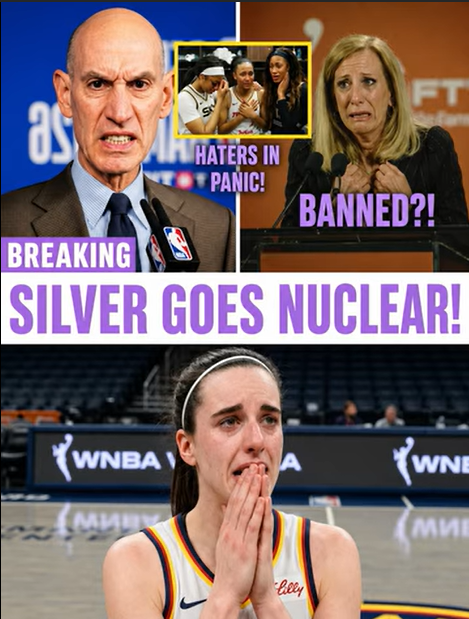
But it is not the secret takeover some viral posts are portraying it as.
Silver has not announced a legal campaign against Clark’s critics. There is no verified public “mandate” threatening ordinary fans or commentators with prosecution for criticizing her.
The real story is arguably more important.
The most powerful executive in American professional basketball has acknowledged that the Caitlin Clark phenomenon has created a problem the WNBA can no longer treat as simply another officiating controversy.
The Moment That Pushed the Debate Over the Edge
One recent incident became a symbol for everything critics believed was going wrong.
During a Fever game against Phoenix, Alyssa Thomas made contact with Clark around the throat area during a play.
No foul was initially called.
Video spread almost immediately.
The reaction was enormous.
Some viewers saw another example of Clark receiving excessive physical treatment without adequate protection from officials.
Others argued that slow-motion replays were exaggerating an accidental basketball play.
The WNBA later reviewed the incident, upgraded it to a flagrant foul and suspended Thomas for one game.
Thomas maintained the contact was accidental.
That should have resolved the basketball question.
Instead, it opened a much larger one.
Why did the league need video review after the game to identify something officials had missed in real time?
Adam Silver Finally Said What Many Fans Wanted to Hear
Silver’s response was carefully measured.
He did not accuse WNBA players of deliberately hunting Clark.
He did not suggest a conspiracy.
He did not demand that Clark receive special treatment.
Instead, he acknowledged the obvious:
The officiating can improve.
That sentence matters because criticism of WNBA officiating has become entangled with arguments over whether Clark is being protected enough.
Silver effectively separated the two issues.
Yes, officiating should improve.
No, the entire cultural war surrounding Clark cannot be explained by whistles.
That distinction may be the most important part of his intervention.
Clark Has Become Bigger Than the Foul Calls
Silver described Clark as an extraordinary player and person who primarily wants to focus on improving her game.
Yet every incident involving her now carries meaning far beyond basketball.
A hard screen becomes evidence of hatred.
A missed foul becomes evidence of institutional bias.
A technical foul becomes evidence of preferential treatment.
A player’s facial expression becomes evidence of jealousy.
A postgame quote becomes a political statement.
That environment is almost impossible for any athlete to navigate.
Clark can simply play basketball.
Everyone else assigns meaning to it.
Silver’s “political football” description captures exactly that problem.
Is Clark Actually Being Targeted?
This is where the conversation becomes difficult.
Clark unquestionably receives physical defense.
There have also been individual plays that the league later determined crossed the line.
But those facts do not automatically prove a coordinated campaign by WNBA players to injure her.
Elite offensive players are frequently defended aggressively because defenders are searching for ways to disrupt them.
Clark’s shooting range and passing ability make comfortable possessions dangerous.
Give her space and she can shoot.
Overcommit and she can create for teammates.
Allow rhythm and she can control the game.
Physicality therefore becomes part of the defensive strategy.
The real issue is not whether opponents should play Clark physically.
They should.
The issue is where officials draw the line.
The WNBA Cannot Create a “Caitlin Clark Rule”
Protecting Clark does not mean protecting Clark differently.
That would create an entirely new controversy.
The league cannot establish one standard for its most commercially valuable player and another for everyone else.
A strike to the head should be evaluated consistently.
A dangerous off-ball collision should be evaluated consistently.
A reckless closeout should be evaluated consistently.
Whether the player involved is Clark, A’ja Wilson, Breanna Stewart, Angel Reese or the final player on a team’s bench should not change the rule.
That is how the league protects Clark without turning her into a privileged exception.
Consistency is protection.
The “Biggest Asset” Argument Is Both True and Dangerous
There is no serious question that Clark has enormous commercial importance.
Her arrival accelerated interest in the WNBA.
Games involving Indiana became major television events.
Arenas filled.
Merchandise moved.
People who had rarely watched women’s professional basketball suddenly knew WNBA schedules, standings and player names.
That makes Clark extraordinarily valuable.
But describing her only as an “asset” creates a dangerous implication.
It suggests she deserves protection because she generates money.
She deserves protection because she is a player.
So does everyone else.
The WNBA’s responsibility is not to keep Clark healthy because ratings depend on her.
Its responsibility is to create a professionally officiated competition where unnecessary dangerous contact is consistently punished.
The commercial benefits follow from that.
Silver’s Real Power Move May Be Pressure, Not Control

There has been considerable speculation about how much influence Silver exercises over WNBA leadership.
That became especially intense after reporting suggested he had played a role behind the scenes following the Thomas incident.
The WNBA publicly denied the characterization that Silver had to persuade Commissioner Cathy Engelbert to suspend Thomas.
Silver himself declined to validate that account.
That leaves an important distinction.
Influence is not the same as intervention.
The NBA and WNBA have deep institutional connections. It would hardly be surprising for senior basketball executives to discuss major controversies affecting either league.
That does not prove Silver secretly took control of WNBA discipline.
His public comments may actually be more significant than any rumored private conversation.
Cathy Engelbert Is Facing an Impossible Balancing Act
WNBA leadership is dealing with several constituencies simultaneously.
Longtime fans do not want the league rewritten around one superstar.
New Clark-driven fans want confidence that she is being treated fairly.
Players want physical competition preserved.
Coaches want consistency.
Broadcasters want compelling basketball.
Sponsors want growth without constant controversy.
And everyone wants the increasingly toxic online conversation to stop consuming the sport.
There is no policy capable of satisfying all those groups.
But there is one thing the league can control:
Its own standards.
Clear officiating.
Transparent discipline.
Consistent review.
That is where leadership has the most credibility to gain—or lose.
The Officials Are Under More Pressure Than Ever
Every WNBA referee now knows what happens after a controversial Clark play.
The clip will be online within minutes.
People will zoom in.
Slow it down.
Change angles.
Compare it with previous incidents.
Former players will analyze it.
Television shows will debate it.
Politicians may even comment on it.
That creates tremendous pressure.
But referees cannot officiate based on social-media consequences.
They must call the action they see.
The solution is not telling officials to “protect Caitlin.”
It is improving positioning, training, review procedures and consistency across the entire league.
The Online Toxicity Is a Separate Crisis
This is where the caption’s idea of “legal consequences” needs an important distinction.
Criticism is legal.
Disliking Caitlin Clark is legal.
Saying she is overrated is legal.
Arguing that another player deserves more attention is legal.
Sports rivalries are built on disagreement.
Harassment and credible threats are different.
Thomas said she received death threats and racial abuse after the controversial incident with Clark.
Clark herself condemned harassment and hate.
That matters.
A league can celebrate passionate fandom while drawing a hard line when disagreement becomes threats, stalking, targeted abuse or other potentially unlawful conduct.
Those are not basketball opinions.
Clark Has Rejected the Hate Being Sent in Her Name
This is frequently lost in the loudest online arguments.
Clark has not asked fans to attack opponents.
She has not demanded that every hard foul become a cultural controversy.
She has publicly rejected harassment.
That complicates the simplistic “Clark versus the WNBA” narrative.
Clark is part of the WNBA.
Her teammates are WNBA players.
Her opponents are colleagues.
The league’s success benefits her.
Her success benefits the league.
Turning every disagreement into a civil war eventually damages everyone involved.
The Players Who Guard Clark Are Not Automatically Villains
The same principle applies to opponents.
Physical defense does not equal hatred.
Trash talk does not equal jealousy.
Competition does not equal conspiracy.
A player can dislike a call involving Clark without disliking Clark personally.
A defender can foul Clark hard without participating in some league-wide effort to stop her success.
Individual dangerous plays should be judged individually.
Once every opponent becomes a villain, actual basketball disappears underneath the narrative.
The League Still Needs Accountability
Rejecting conspiracy theories does not mean pretending everything is fine.
The Thomas sequence showed why postgame review exists.
If officials miss excessive contact, the league should correct it.
If a play warrants a flagrant classification, classify it.
If the rules require suspension, suspend.
And then apply exactly the same process the next time the player receiving the contact is not Caitlin Clark.
That is how the WNBA can answer its critics without surrendering to them.
Why Silver’s Comments Carry So Much Weight
Silver does not run the WNBA’s day-to-day officiating.
But his words carry enormous institutional authority.
When he acknowledges officiating needs improvement, the statement validates at least part of the criticism without endorsing the more extreme narratives surrounding it.
And when he says Clark is being used as a political football, he is warning everyone that basketball has been swallowed by agendas far beyond basketball.
That may be the closest thing to a “mandate” supported by the public record:
Improve the game.
Stop turning Clark into a symbol for every political argument.
Let her be a basketball player.
There Is No Evidence of a Secret Legal Purge Against “Haters”
The most dramatic version of this story claims critics should suddenly fear legal consequences.
That goes too far.
Sports leagues cannot punish ordinary people simply for criticizing athletes.
Neither Silver nor WNBA leadership has the authority to erase protected speech because it is unpleasant.
Where legal issues can arise is when behavior crosses established boundaries—credible threats, stalking or other unlawful conduct.
That is very different from being a “hater.”
Fans should be able to criticize Clark.
Fans should be able to criticize Reese.
Fans should be able to criticize Silver.
What nobody should have to accept is threatening abuse.
The WNBA’s Greatest Opportunity Is Hidden Inside the Chaos
:max_bytes(150000):strip_icc():focal(999x0:1001x2)/caitlin-clark-indiana-fever-042224-98889a0758fb4446b49de43719c6a748.jpg)
There is an irony underneath the controversy.
People care.
Millions of people are arguing because the WNBA has become culturally significant enough to argue about.
Clark helped accelerate that transformation.
But attention is only valuable if the league can convert it into long-term attachment.
New fans need to discover more players.
More rivalries.
More teams.
More stories.
Clark can be the doorway.
She cannot be the entire building.
If every WNBA conversation remains a referendum on Caitlin Clark, the league’s growth eventually becomes dependent on one person.
That is not sustainable.
What Should Happen Next
The best response is less dramatic than the viral headlines suggest.
Improve officiating.
Apply flagrant-foul standards consistently.
Explain controversial disciplinary decisions clearly.
Protect every player from genuine threats.
Reject racial and other hateful abuse.
Allow physical basketball without allowing dangerous basketball.
And stop forcing Clark to represent ideological battles she never volunteered to fight.
None of those reforms require a secret takeover.
They require professional league management.
Adam Silver Has Entered the Debate, but Clark Should Not Need a Savior
That may be the final contradiction.
People demanding that Silver “save” Caitlin Clark are reinforcing the very phenomenon he criticized.
They are turning her into something beyond a basketball player.
Clark does not need the NBA commissioner to declare war on her opponents.
She needs competent officials.
Consistent rules.
A safe workplace.
Fair competition.
And the freedom to succeed or fail based on basketball.
Her opponents deserve exactly the same.
The WNBA has reached a moment where every decision is magnified because the audience is larger than ever.
That is not a crisis unique to women’s basketball.
It is what happens when a sports league becomes genuinely important.
Adam Silver’s intervention should therefore not be interpreted as the beginning of a purge against Clark’s critics.
It is better understood as a warning.
The WNBA’s growth has outpaced its ability to treat every controversy like a small-league problem.
The spotlight is enormous now.
The officiating must improve.
The discipline must be consistent.
The online abuse must be separated from legitimate criticism.
And Caitlin Clark must be allowed to compete without every collision becoming another battle in America’s culture wars.
The game has indeed changed.
But the most important “mandate” is not complicated:
Make the basketball worthy of the attention it is finally receiving.