
Caitlin Clark and Paige Bueckers Finally Let Loose After Team USA Won Gold — The Locker Room Said Everything the Box Score Couldn’t
For most of the tournament, Caitlin Clark had been asked to stay composed.
Accept the rotation.
Wait for her minutes.
Enter from the bench.
Make an impact quickly.
Move the ball.
Trust the veterans.
Ignore the noise.
Then Team USA finally won the gold medal, the locker-room doors closed, and all of that restraint disappeared.
The cameras caught something completely different from the tense basketball discussions that had surrounded the Americans for days.
No debates about starting lineups.
No arguments about playing time.
No questions about whether Clark should have received a bigger role.
No analysis of Paige Bueckers’ minutes.
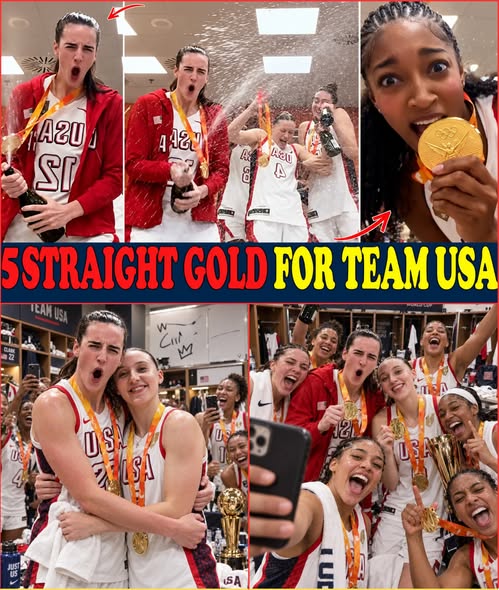
Just players screaming, dancing, laughing, showing off their championship gear and celebrating the fact that they had completed the job they came to Germany to finish.
For Clark and Bueckers especially, the scene felt significant.
They had spent the tournament as part of a younger group constantly being compared with Team USA’s established stars.
Inside that locker room, none of that mattered anymore.
They were champions too.
The Celebration Looked Completely Different From the Pressure Outside
International tournaments create strange environments.
A team can be winning while almost every individual decision is still being questioned.
That was especially true for Team USA.
Clark’s role became a daily discussion.
Bueckers generated her own attention whenever she checked into games.
Angel Reese, Aliyah Boston and the rest of the younger group were frequently measured against the veteran rotation.
Every game produced another argument.
Who should start?
Who should play more?
Which lineup looked fastest?
Which player was being underused?
But after the final, basketball hierarchy temporarily disappeared.
Gold medals have a way of doing that.
The videos from the locker room showed players enjoying the kind of moment that doesn’t require explanation.
Someone shouted.
Someone danced.
Championship hats appeared.
Medals were shown to the camera.
There was music everywhere.
One voice proudly announced that she had come for something and wasn’t leaving empty-handed.
That might as well have been the theme of the entire night.

Clark Finally Had Something Nobody Could Debate
Almost everything surrounding Caitlin Clark generates an argument.
Her shot selection.
Her passing.
Her turnovers.
Her popularity.
Her minutes.
Her role.
Her relationship with coaches.
Even good performances somehow become the beginning of another debate.
But the medal around her neck was different.
There was nothing subjective about it.
Clark came to the tournament seeking a senior international championship.
She left with one.
That matters because her tournament had not been perfectly smooth.
She experienced big moments.
She experienced difficult ones.
She had stretches where her passing changed the entire tempo of the game.
She also had moments when she struggled to find rhythm.
And throughout it all, she operated in a role far smaller than the one she normally occupies with Indiana.
For an athlete accustomed to controlling the basketball and shaping almost every important possession, that required adjustment.
The locker-room celebration was the release after all of it.

Paige Bueckers Shared the Same Strange Journey
Bueckers entered the tournament in a similarly unusual position.
She is used to being one of the central figures wherever she plays.
With Team USA, she became one piece of an extraordinarily deep roster.
That meant waiting.
Adapting.
Entering without always knowing how long the opportunity would last.
And trying to produce before another rotation change came.
Bueckers and Clark have spent years being compared.
Their college careers were compared.
Their games were compared.
Their popularity was compared.
Even their Team USA warmups became content for fans eager to turn every shared moment into a competition.
Yet inside the locker room after the final, the rivalry storyline looked almost irrelevant.
They had reached the same destination.
Gold.
Sometimes winning has a way of making all the manufactured comparisons look smaller.
The Young Players Had Earned the Right to Celebrate
One of the biggest storylines of Team USA’s run was the difference between the veteran group and the younger players.
At times, the younger unit seemed to inject immediate speed into games.
Clark could push the ball.
Bueckers could attack or create.
Reese could crash the glass.
Other young players brought energy that changed the rhythm when they entered.
That led some fans to demand larger roles.
But those players never needed to win the rotation argument in order to contribute to the championship.
They only needed to be ready.
That is one of the hardest parts of playing on a roster filled with stars.
A player may receive 25 minutes one night and barely appear the next.
The role can change before the player has time to become comfortable.
The celebration showed the emotional payoff for accepting that uncertainty.
They didn’t all have the tournament they would have had as the unquestioned stars of their professional teams.
They still got the same medal.

The Final Made the Celebration Feel Even Better
Team USA did not walk through the championship game without resistance.
France made the Americans uncomfortable early.
The first half tested them.
For stretches, the possibility of losing felt real enough to change the atmosphere completely.
That made the second-half response more satisfying.
Team USA tightened defensively.
The offense stabilized.
The experienced stars delivered.
The younger players contributed when their opportunities arrived.
And eventually the Americans created enough separation to turn a tense final into a gold-medal victory.
That journey from discomfort to control explains the emotion afterward.
Locker-room celebrations often look chaotic because the pressure disappears all at once.
For weeks, every possession matters.
Then suddenly none of them do anymore.
The tournament is over.
There is nothing left to protect.
Nothing left to prepare for.
Just the medal.
Clark Can Finally Return to Indiana Without the Tournament Hanging Over Her
For Fever fans, the most interesting part may be what happens after the celebration ends.
Clark returns to Indiana as a gold medalist.
And perhaps more importantly, she returns to a completely different basketball environment.
With Team USA, she had to fit.
With Indiana, she is expected to create.
Those are very different responsibilities.
She can once again push the tempo consistently.
She can initiate possessions.
She can work with Kelsey Mitchell.
She can find Aliyah Boston.
She can reward cutters and shooters.
And she can attack from the kind of distances that force entire defenses to adjust.
The World Cup demanded patience.
The Fever will demand aggression.
That contrast could be useful.
Bueckers Leaves With Something Important Too
The same can be said for Bueckers.
International tournaments compress experience.
Players are exposed to unfamiliar teammates, coaching styles, defensive schemes and expectations almost immediately.
There isn’t much time to become comfortable.
You learn while competing.
Winning gold makes that learning easier to appreciate.
Bueckers didn’t need to own the tournament to benefit from it.
Neither did Clark.
Sometimes the most valuable experience for a young star is discovering how to contribute when the team doesn’t belong to you.
One Locker-Room Video Captured the Part Fans Rarely See
Fans spend enormous amounts of time debating basketball as if every decision creates permanent division.
Starter versus reserve.
Veteran versus young player.
Clark versus Gray.
Clark versus Bueckers.
One lineup versus another.
But the people actually playing the game often experience it differently.
They compete for minutes.
They want larger roles.
Of course they do.
Then they win together.
And suddenly the person who played 30 minutes and the person who played five are both wearing gold medals.
That is what made the locker-room footage enjoyable.
It wasn’t polished.
It wasn’t strategic.
Nobody was explaining the rotation.
Nobody was defending a coaching decision.
They were simply happy.
For One Night, There Was No Clark Debate
There will be plenty of time for the Caitlin Clark conversation to begin again.
It always does.
Indiana’s next game will produce another one.
The playoffs will create more.
Every matchup with another star will become another comparison.
But for one night in Berlin, the conversation became wonderfully simple.
Caitlin Clark won gold.
Paige Bueckers won gold.
Team USA won gold.
They screamed.
They danced.
They showed off their medals.
And after a tournament where nearly everything surrounding Clark had been analyzed, questioned and argued over, the locker-room celebration finally gave her something basketball rarely provides anymore.
A moment that didn’t need to be explained.